One of the goals of gut microbiome research is that scientists will be able to develop treatments for various diseases that add or restore microbes with health benefits that are missing from the gut. This isn’t as simple as just packing microbes into a probiotic capsule, though. Sometimes the most beneficial bacteria need a few tweaks before they can do their jobs.
A new study by researchers from the University of Chicago provides a genetic toolkit to engineer a common, but difficult to work with, family of bacteria in the human gut microbiome that produces metabolites that are linked to intestinal and metabolic health. Using this toolkit, they engineered bacteria to produce an additional immune protein that helps protect the lining of the gut. In a mouse model, the enhanced bacteria improved symptoms of metabolic liver disease, showing that this family of bacteria, and perhaps others, can be reprogrammed to improve health.
“We wanted to develop genetic tools to learn something about the biology of these microbes and why they might be so protective for health. Can we engineer additional features in them that might be used as a therapeutic?” said Mark Mimee, PhD, Assistant Professor of Microbiology and Molecular Engineering at UChicago and senior author of the study. “This work is a proof of concept that opens the possibilities to engineer a whole family of microbes that has potential beneficial effects.”

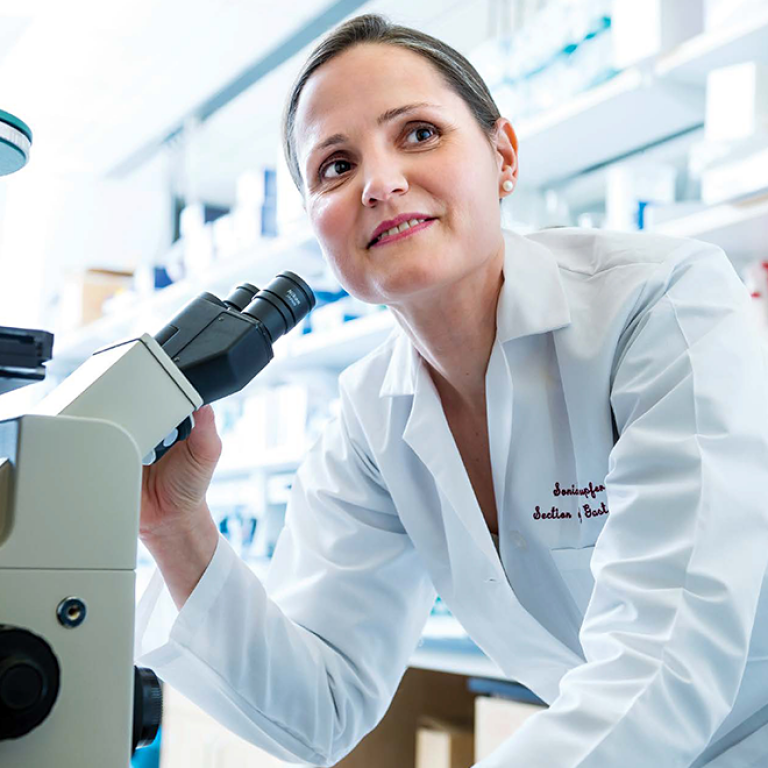
Mark Mimee, PhD
Assistant Professor of Microbiology
Committee on Molecular Metabolism and Nutrition
Updating the canaries in the coal mine
Two former graduate students in Mimee’s lab, Jack Arnold and Sandra McClure, led the project and co-authored the new study, which was published in Nature Microbiology. They worked with a family of bacteria called Lachnospiraceae that help ferment dietary fiber and convert it into short-chain fatty acids like butyrate that are known to support gut health. These bacteria are also associated with protection against colon cancer, resistance to pathogens, and immune system regulation.
Despite their promising benefits, Lachnospiraceae are also difficult to work with. They are anaerobic, which means they are sensitive to oxygen, making them fragile under lab conditions. There are also few genetic tools for manipulating them, unlike other common model bacteria like E. coli.
“They’re kind of the canaries in the coal mine. They’re well-known, health-associated bacteria that produce a lot of metabolites and immunomodulatory molecules that maintain health and homeostasis in the gut. But when people get sick, these are the first types of bacteria to go away,” Mimee said. “So, this whole family of microbes was generally understudied because they’re difficult to grow and more or less impossible to use for any genetic studies.”
Some distant cousins of these bacteria have been engineered for industrial uses to break down biomass and agricultural waste into biofuels and chemicals. So, the team started with genetic tools built for those purposes and worked to adapt them for Lachnospiraceae.
Eventually, they were able to engineer a strain of Coprococcus comes, a common member of this family native to the human gut, so that it produced an immune protein, or cytokine, called IL-22 that triggers genetic activity to protect the epithelium, or the lining of the intestine. Scientists from Weill Cornell Medicine used a similar approach to engineer metabolic functions of other Lachnospiraceae species earlier this year.